Writing As a Puzzle: Literary Universes and Their Boundaries
Did you know that all writers have a superpower?
It’s not a power we can wield in our everyday life. Using super strength to lift cars, or mind control to force readers to buy our latest book.
If you’re a writer reading this, you have this power too, even though you might not know it. And it’s the strongest superpower of all.
Time travel.
You can outline a story from beginning to end before writing a single word. You can plan the final scene before you start writing the first. You can go back and cut out things–erase chapters from the past, or move them into the future. You can even write chapters out of order if it strikes your fancy (or if it helps you get around writer’s block).
One of the most effective ways you can use this power is to the effect of deconstruction.
You can make plot points more complex and interesting by breaking them down, feeding your readers hints and pieces of them. Scattering bread crumbs back through time. Going back to set up teasers for things that have already happened in the future. Because when your readers have to anticipate and fill in the blanks, it keeps them engaged.
But when does deconstruction become too much? How many readers will be turned off when they find out your narrative is a 1000-piece puzzle? And even if they’re keen for such a sprawling mystery, how can they trust that every piece will click in place by the end?
Perhaps it helps to break down that 1000-piece puzzle. Deconstruct the deconstruction.

One of the smartest things the Marvel Cinematic Universe (MCU) did was ditch numbering sequels.
Barring Iron Man, the varied superhero films all use subtitles instead of numbering. The subtitling implies that you don’t have to see them in order. It also lightens the burden of the MCU’s history on future installments. It feels less like you have to “do your homework” and must watch Thor 1, 2, and 3, before the 4th one. You don’t have to worry as much about “falling behind” on the lore, you can jump in and out, select which movies you want to see. Maybe take a little sidequest and watch one of the TV shows or pick up the tie-in comics. The MCU as an “open world” to explore. Omnidirectionality feels liberating and exciting.
It’s a formula that many other studios tried to cash in on, with their own “cinematic universes,” but most ended up being too loosely connected. After all, it’s hard to organize multiple different directors/writers/producers over multiple decades into one singular narrative framework.
I think that’s a bit of a shame.
We all loved the connections, the cameos of different heroes in each others’ films, the enticing post-credits scenes. The sprawling “1000-piece” nature of the overall narrative didn’t feel overwhelming, because we didn’t have to solve it all at once.
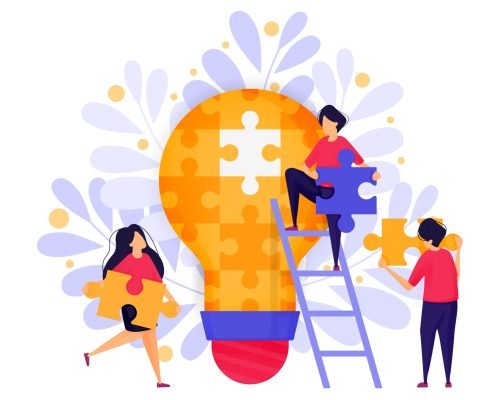
The human brain is wired to want to put disconnected events together. Even to invent grand narratives and conspiracies out of pure coincidence. (Humans are notoriously bad at feeling out probabilities.) This is why you don’t have to shine a spotlight on the greater puzzle, most readers will naturally gravitate towards wanting to solve your breadcrumbs, even if your immediate narrative is something simpler.
And it’s more fun when these pieces pop up “by chance” rather than dumping all 1000 of them on the floor at once. It’s more enjoyable when the focus of the audience is directed on the micro-narrative (like an individual entry in the MCU), and the chipping away of that 1000-piece puzzle happens incidentally. The important thing is it’s not forced on the reader all at once. It also means if the reader misses one piece of the greater narrative, they’re not going to fail their history exam. The reader only “has” to know what’s happening right now, in the micro-narrative, and the greater connections are just a bonus. And hopefully, demonstrating control of the micro-narrative gives your readers a little more confidence in your broader puzzle.
Cinematic universes may be tricky, but perhaps a “literary universe” of sorts is more achievable.
This technique taps in more broadly into my favorite fundamental ur-block of storytelling. That’s when a narrative is crafted with the duality of “simple thing happening on the surface/more complex thing happening underneath.” This is only my first blogpost, but you’re going to hear me talk about that a lot. It’s not just that such a story construction can be the “best of both worlds” (the more immediate and accessible action and emotion of a simpler story plus the staying power of a more complex story), it’s that both sides can feed each other in interesting ways. Mirroring the relationship between the conscious and subconscious mind. What we learn about one tells us about the other.